
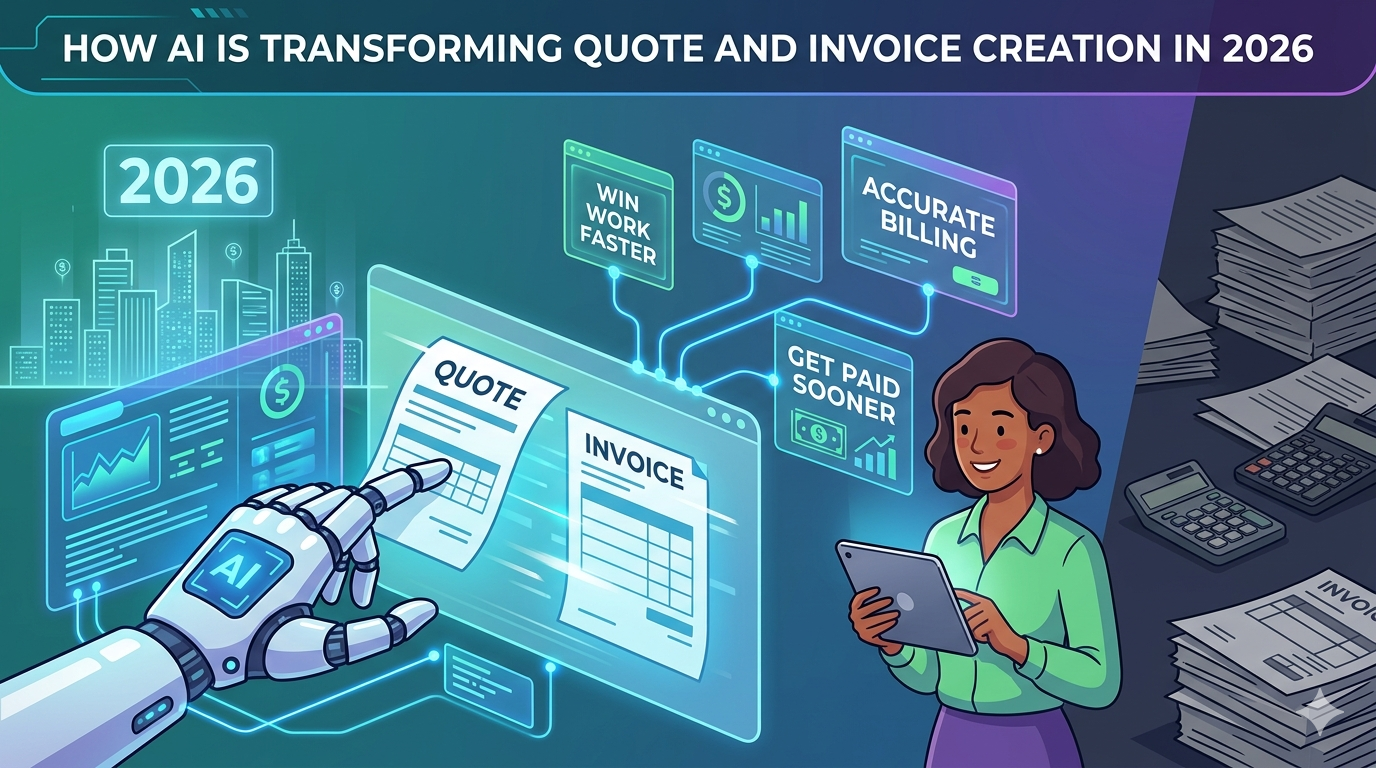
How AI Is Transforming Quote and Invoice Creation in 2026
Faster workflows, smart pricing, automated follow-ups, and better cash flow for modern businesses
How AI Is Transforming Quote and Invoice Creation in 2026
AI is changing quote and invoice creation from a manual back-office task into a faster, smarter revenue workflow. In 2026, businesses do not just want to send documents, they want to win work faster, bill accurately, and get paid sooner.
For freelancers, agencies, contractors, and small businesses, this shift matters more than ever. The companies that adopt AI-powered quoting and invoicing now are cutting admin time, reducing errors, and improving cash flow while delivering a smoother client experience.
Why Quote and Invoice Workflows Needed a Reset
Traditional quoting and invoicing tools were built around accounting tasks first. That meant teams often had to jump between templates, client records, payment tools, and follow-up reminders just to complete a simple sales cycle.
The result was predictable: slow quote creation, duplicated data entry, and missed follow-ups. Orchid Office’s product documentation reflects this pain clearly, describing the old workflow as fragmented and too manual for fast-moving service businesses.
AI Makes Document Creation Faster
One of the biggest changes in 2026 is how quickly a user can create a polished quote or invoice. AI can now generate draft quotes from a short description, suggest line items, apply pricing rules, and turn approved estimates into invoices with minimal rework.
QuickBooks and Zoho both show how this trend has moved into the mainstream. QuickBooks now offers AI-assisted invoice generation and autofill from job details or pasted notes, while Zoho supports automatic quote-to-invoice conversion once an estimate is accepted. That proves the market is moving toward faster, lower-friction billing workflows.
Smarter Pricing and Fewer Mistakes
AI is not only about speed. It is also helping businesses price more intelligently by suggesting common line items, estimating effort, and applying rules consistently across recurring work. That is especially valuable for freelancers and agencies that quote similar services over and over.
Orchid Office’s architecture emphasizes human-in-the-loop control so totals stay accurate and calculations are always validated before sending. That approach matters because AI should assist the workflow, not replace financial judgment.
Quote to Invoice Without Duplication
A major breakthrough in modern invoicing software is one-click quote-to-invoice conversion. Once a client accepts a quote, the details can flow directly into the invoice without re-entering client information, line items, or terms.
This saves time and reduces errors at the exact point where many businesses used to slow down. Products like Zoho already support this kind of conversion, showing how standard this feature has become in 2026. Orchid Office is designed to push this further by linking quotes, invoices, payments, and client history into one revenue workflow.
Follow-Ups That Actually Happen
Getting a quote approved or an invoice paid often depends on timing. AI helps here by sending reminders, nudges, and payment prompts automatically, so businesses do not have to chase every client manually.
This is a big deal because late payments remain common, and many teams still struggle with overdue invoices. Xero and QuickBooks both emphasize automation and smarter receivables workflows, while industry reporting continues to show that AI is being used to predict late payments and improve tracking. In practice, this means AI is becoming a cash flow tool, not just a document generator.
Voice and Conversational Input
In 2026, the best quote and invoice tools are becoming more natural to use. Orchid Office’s product documentation highlights voice-based quote creation, conversational editing, and AI-powered data extraction from speech or plain language input.
That changes the experience for busy founders and field-based service providers who do not want to spend time filling out fields manually. Instead of navigating a long form, they can describe the job, review the draft, and send it quickly. This is the kind of workflow that makes AI feel practical rather than trendy.
Better Cash Flow Visibility
AI is also improving the way businesses see their revenue pipeline. Modern quoting and invoicing platforms now surface key metrics like outstanding invoices, conversion rates, payment status, and average deal size in real time.
That visibility helps owners understand where money is stuck and where sales are moving smoothly. Orchid Office’s product direction makes this especially clear by tying quote creation, invoice tracking, and payment insights into one dashboard built for revenue clarity. The benefit is simple: better decisions with less guesswork.
Why Orchid Office Fits the Moment
Orchid Office is positioned for the exact shift happening in 2026. The platform is designed as a sales-first, cashflow-first system that unifies quotes, invoices, CRM, analytics, and AI automation instead of treating billing as an isolated accounting task.
That makes it especially relevant for freelancers, agencies, and SMBs that need speed, simplicity, and smarter follow-through. With AI-assisted quote building, invoice conversion, embedded payments, and workflow automation, Orchid Office is built for businesses that want to move faster without losing control.
What Comes Next
The future of quote and invoice creation is not about adding more fields or more screens. It is about reducing friction, improving accuracy, and helping teams get paid with less effort.
In 2026, AI is making that possible by turning billing software into a proactive assistant. For modern service businesses, that means less admin, better margins, and a smoother path from quote to cash.